Showing posts with label matthew 6. Show all posts

Sunday, October 25, 2026

Heavenly Treasure (Matthew 6:1-6, 16-21)

 It was a spring evening in 2017, nine years ago. I had just parked my car about a half mile from Disneyland (because I was too cheap to pay to park in the parking lot), and was walking to the park for a special event that I somehow got tickets to.

My cellphone rang. It was my associate regional minister. I answered it.

He said: “Hey, we’re planning a summer trip for youth to go to Hawaii, learn about the culture, and take part in service projects. We’ve got some great young adults going as chaperones… but, we need someone (like you) with a little more experience to go and oversee things. Most of the planning has already been done, we just need you to go and be present, if you are willing.”

Heck ya!

A few months later, I was in Hawaii, a place I had only dreamed about. And along with the youth and young adults on that trip, I learned so many things about Hawaiian history and culture that I never knew before.

***** One of the places we visited was Iolani Palace, a place that made such an impression on me that I made sure to take my own family there when we visited a few years later.

King Kalākaua, also known as the “merrie monarch,” built Iolani Palace in 1882. It was the home of Hawaii's last reigning monarchs and served as the official royal residence and the center of the Kingdom’s political and social life until the overthrow of the monarchy in 1893.

After that, it was taken over by occupying forces from the United States. Queen Liliʻuokalani—King Kalākaua’s sister and the last Hawaiian monarch—ended up imprisoned in one of the rooms of the palace for eight months.

In 1962, Iolani Palace was designated a National Historic Landmark. It was restored, and today is the only official royal residence in the United States.

***** What I didn’t know about Iolani Palace until just recently is the role Abigail Kawāna.nakoa played in preserving and maintaining the palace.

Because the palace contains many important artifacts, the air conditioning needs to run 24 hours a day, and costs about $15,000 a month. Abigail Kawānanakoa paid this bill, quietly and secretly for many years. 

Hawaiians call her the last princess. Her grandfather was Prince David Kawānanakoa. She also had a great-grandfather named James Campbell, whose sugar fortune was one of the largest estates in Hawaii. This meant that Abigail Kawānanakoa inherited the bloodline of a kingdom and the money of the plantation era that replaced it.

In addition to paying the palace’s electric bill, she also funded scholarships, paid medical bills, and helped cover funeral costs. All in secret.

Eventually, though, the secret got out. After she died in 2022 at the age of 96, 

Abigail Kawānanakoa was carried into the Throne Room of Iolani Palace in a casket carved from a single 165 year-old koa tree. More than 1,600 people waited hours in line to walk past her. No royal had lain in state there in over a century. And her wife Veronica stood beside the casket for all six hours.

Abigail Kawānanakoa never got to rule anything, since the monarchy ended 33 years before she was born. Yet she spent 96 years taking care of its people. Quietly. Secretly. 

We have a lot of people in our church like Abigail Kawānanakoa. People who do so much, and who give so much, with no expectation of reward or acknowledgment. I sometimes feel that a big part of my job as pastor is (or should be) expressing gratitude to those who give so much to make our ministry happen. 

But that would be impossible. 

One, it would be impossible to express all the gratitude that is due, and two, I don’t even know who gives what, because most of what is given, at least in terms of monetary gifts, is given in secret.

**** And one reason that we give in secret is because of what our scripture today teaches.

“Whenever you give, do not sound a trumpet before you… but when you give, give in secret.”

…Giving was assumed. Jesus doesn’t say “IF you give.” He says “when you give.” A faithful person gives. 

I’m struck by the fact that Jesus said this, even though he had his own disagreements with the temple authorities. Heck, some of those who taught in the temple wanted Jesus arrested! 

But the temple is more than just those in charge. The temple is more than those who exercise their authority or power.

At First Christian Church, power and authority are shared. I’m thankful for that. I’m thankful that this church is more than those who lead it: its pastors (past and present), its elders and board members. 

Because none of us is God. None of us is infallible. And I know I’m not going to get things right every time. I try, but it’s just not going to happen.

So thank God that this church is bigger than any one person. 

And thank God that, no matter how good or bad the sermon is, we still get invited—every single one of us—to gather at the Lord’s table, to commune with God, through Jesus Christ—and receive again the love and the life that is pure goodness and grace.

That’s why we give to the church.

And when you give (Jesus says), give in secret.

That may be a challenge for some. We’re not used to being asked to give in secret.

At the very least, we expect a free tote bag in exchange for our pledge! Am I right?

And maybe get our name listed in the annual report, along with all the other donors… with those who gave the largest gifts listed first, in an easy-to-read size font, and those who gave smaller amounts still listed, but in smaller print…

But we don’t do that. No one knows how much you give, not even me; only our financial secretary knows, so that you can receive a statement that you can include when you file your taxes.

We do, however, know some general demographic data.

***** We know that, generally speaking, most of those who pledge to the church are older. The older you are, the more likely you are to pledge.

Currently, we have no pledges at all from anyone under the age of 40. That doesn’t mean people under 40 don’t give; but it does mean that they haven’t made a commitment to give that they plan to honor throughout the year.

Perhaps some of the blame for that can be placed upon me and the other leaders of the congregation.

We don’t like to talk about money. We don’t like to ask for money. And so we do very little in the way of educating people about money.

And yet, in one way or another, Jesus talks more about money than anything else except the kingdom of heaven.

The two are, in fact, related. Jesus often talks about money, and the kingdom of heaven, in one breath.

It’s NOT because you can buy your way into heaven. 

But what you spend your money on does speak to what you value in your heart. 

So if you say your heart is set on God and on the kingdom of heaven, yet you spend your money on things that are not aligned with God’s kingdom, then there’s a discrepancy there. Your actions aren’t matching what you say you value. Which means you lack integrity. Which means your life is split; broken; fragmented. 

And you’re left feeling less than whole.

***** If we had kept reading in the 6th chapter of Matthew, we would have come upon Jesus teaching his disciples to pray; and that prayer he taught them, which we pray every Sunday, talks about debts and debtors, and about the kingdom come on earth as it is in heaven… [6.9-12]

***** And further still in this chapter, we then come to Jesus’ instruction that we seek first the kingdom of God—and all these things (all the things we need on this earth to survive, to thrive, to prosper) will be given to us as well. [6:33]

***** And in the middle of it all, still in Matthew chapter 6, Jesus says: “Do not store up for yourselves treasures on earth, where moth and rust consume and where thieves break in and steal; but store up for yourselves treasures in heaven, where neither moth nor rust consumes and where thieves do not break in and steal. For where your treasure is, there your heart will be also.” [6:19-21]

Let your life be in alignment with your heart.


***** So yes, we are asking you to make a pledge for 2027. 

And we are inviting you to give in secret. To pledge in secret. That way, it is a decision of your heart, motivated not by any thought of earthly reward, but by the things you value most.

That way, your soul can feel the integrity of your life, and you can experience wholeness in your being. 

The fragmentation and brokenness we feel when our heart values one thing but our lifestyles don’t match… will be overcome.

Do you value love? Joy? Peace? Kindness? Goodness? These fruits of the Spirit are what we hope the Spirit will work in us and through us, for our sake and the sake of our neighbors near and far.

Do you value justice? Hope? Freedom and liberation? Do you value the right of every person to know that God loves and affirms them, just as God created them? 

Do you value the good news of Jesus, the news that brings life to those who have only had life sucked out of them by this often cruel world?

These are the things this church stands for. And if these are the things you value in your heart… then please make a pledge… because where your heart is, there your treasure will be as well.

And if you’ve never made a pledge to the church, then I especially encourage you to do so. 

Now, maybe you can’t afford to give much, and that’s why you’ve never pledged. Maybe you have a hard time affording necessities, like food, or gas.

But I bet you can pledge something. Five dollars a week? One dollar a week?

If ten people who have never pledged before give one dollar a week, that’s 52 dollars a year from each of them, or 520 dollars total from all ten of them. And yeah, that’s not much when compared to our church budget…

But being able to say that we have ten new pledges… among other things, it will let those who can afford to give more, and who do give more, know that they aren’t in this alone, that you join with them in supporting the ministry of this church, despite your limited finances. Even if you can’t give much, making a pledge is a sign that this is where your heart is.

We’re inviting you to give from the heart. Make a pledge that your heart will be proud of. Make a pledge that reflects the things you value in this world.

Make a pledge, so that the values you hold deep in your heart are reflected by how you live, and what you spend your money on.

Make a pledge not in order to receive the grace and goodness of God, but because you have already received the grace and goodness of God, and you want others to know that God’s grace and goodness is for them as well.

There are so many ways that we share God’s love, that we let people know that they are loved, that they are not alone, that no matter how difficult things are right now, that someone is there with them, beside them, walking with them on that journey.

We do that when we pray for one another, and when we stock our Helping Shelf, and when we run our youth program, and when we partner with other local organizations to bring wholeness in so many ways to our community and beyond.

Isn’t that something your heart wants to be a part of? 

Listen to your heart. Listen to what God is saying to you in this Stewardship season. And let your life reflect the things you hold most dear


Sunday, February 8, 2026

Seek First God's Kingdom (Matthew 6:24-34)

 Integrity is a word that has kind of followed me around for much of my life.

The first time it really grabbed my attention was over 30 years ago when I interviewed for a job, and the person who interviewed me said afterward that he would not be hiring me because I lacked integrity. 

This was before I became a minister, before I went to seminary. I had applied to work with a good organization that I really liked, but which had policies that were homophobic. 30 years ago, that was not unusual, though this particular organization was already starting to feel some pressure to change its policies.

The person interviewing me asked me if I was OK working for this organization and supporting its homophobic policies. (He didn’t use the word “homophobic,” but whatever.)

I said—because I really liked this organization and really wanted this job—that if I was hired, I knew that I would be expected to enforce the policies. And I would do so. I also said that if I felt that any policies were unjust or immoral, I would advocate for change within the organization, to help make the organization even better than it already was.

He didn’t like that answer. In his eyes, I lacked integrity.

And maybe I did. To work for an organization that held ideas that I considered immoral… and to be expected to enforce those policies, even if I didn’t agree with them… Is that lacking in integrity?

It made me think about people I know who worked for the church. Pastors and all other sorts of people, working in all sorts of different types of churches… some of them paid, some of them volunteers… And some of them straight, and some of them gay. 

All of them believing in affirming people of all sexual orientations and gender identities; all of them believing that the church should be affirming of people of all sexual orientations and gender identities.

But not all of the churches they worked for did.

Yet they loved the church, they loved what the church taught them about Jesus; and because of what the church taught them, they believed that Jesus unconditionally loves and affirms all people. 

So they stuck with the church, hoping and praying and working for the day that those churches would realize that our God is an inclusive, affirming God, and that churches should convey that love in every aspect of their ministry.

And many of those churches, over the years, did change, and now they do welcome and affirm all God’s children.

Now: were they lacking in integrity by working for a church before that church became inclusive and affirming?

It’s really hard to judge, isn’t it? It’s complicated. But I think most of them are to be commended.

Looking back, I think the organization I interviewed with was lacking integrity more than I was…and the organization came to realize that as well. A few years later, they got rid of their homophobic policies.

But I still wonder what it would have been like if I had been hired, before they changed their policies. I don’t know exactly how that would have played out. It may be that the issue wouldn’t have really come up much in my professional duties. But maybe it would have… and how would I have responded?

Having thought about integrity, I have come to define integrity as acting in a way that is consistent with who you say you are. It means walking the walk, and not just talking the talk. It means if you claim certain values, and if you encourage others to live by those values, that you try to live by those values yourself. 

You don’t say, “this is who I am, this is what I believe…” and then act in ways that are contrary to what you’ve just proclaimed.

****** One of the best things our denomination’s General Minister, Terri Hord Owens, has done, is encourage us as a church to “be the church we say we are.” We say that we are a pro-reconciliation, anti-racism church; let’s show the world this is who we are by the way we live and by the work we do, not just the words we say. 

We say we are a movement for wholeness in a fragmented world… so let’s get out there and actually work for wholeness, for all of God’s people. 

This is what it means to have integrity. It means we actually prioritize, in our lives and in the work we do, things that are in line with the values we claim. We don’t claim certain beliefs and values, and then live lives that demonstrate that our real values and priorities aren’t what we say they are.

And because—ever since that interview—I have thought a lot about integrity, I ponder and meditate on things. For example: I claim to be a person who prioritizes caring for the earth and protecting our climate—yet I still get around town in a vehicle that burns fossil fuels.

This leads me to ask myself: how can I continue growing in integrity? What changes can I make to my life, so that my actions and my lifestyle are more in line with the things I say are important to me?

How can I live with greater integrity?


***** In today’s scripture, Jesus says to seek first the kingdom of God. In other words, make God’s kingdom your number one priority. 

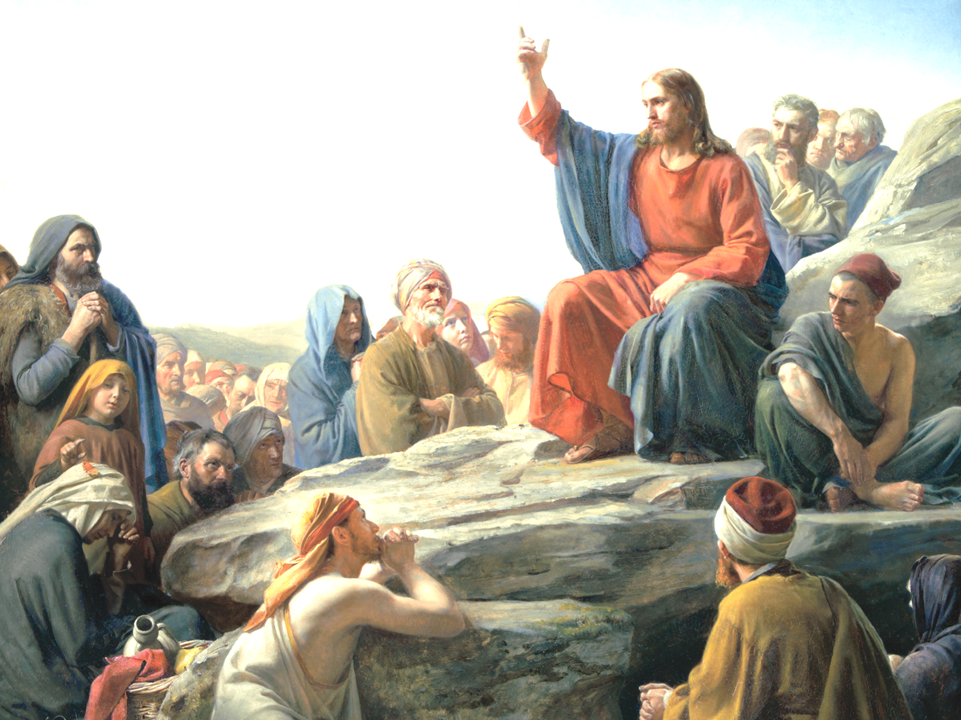
And God’s kingdom is everything that Jesus talks about in the Sermon on the Mount. 

God’s kingdom—the kingdom we are instructed to seek first—is the kingdom where the poor are blessed… the kingdom where the peacemakers are blessed…the kingdom where those who hunger and thirst for what is right are blessed… the kingdom where the meek and the merciful and the pure in heart are blessed.

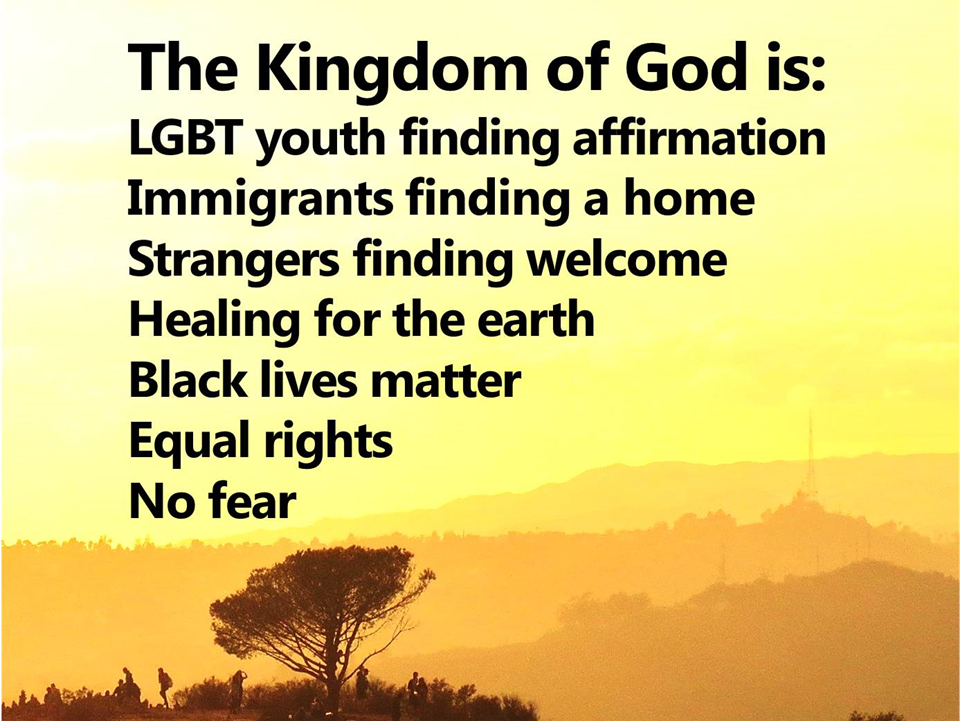
God’s kingdom is where LGBT youth find affirmation; where immigrants find a home; where strangers find welcome; and where Black lives matter.

(What else should we add to this list?)

God’s kingdom is where women and girls are protected, and do not walk in fear.

God’s kingdom is where families are nurtured and supported… and not torn apart.

God’s kingdom is where those who are sick are cared for.

God’s kingdom is where those who mourn find comfort.

Seek first this kingdom. Seek first the righteousness of God, who reigns over this kingdom with love and compassion.

We claim to be people who seek God’s kingdom. Every Sunday, when we pray the Lord’s Prayer, we pray that God’s kingdom may come on earth, as it is in heaven. 

But then we leave here, and we go about our lives, and we focus our attention on so many other things. We make compromises every day. And we worry so much about so many things, while neglecting the kingdom of God. 

***** What shall I eat? What shall I wear?

When Jesus talked about worry, I wonder if he was responding to those who wanted to follow him, but were held back by these cares and worries. 

If I follow you, Jesus, who will provide for my family? Who will pay the bills? Who will mow the lawn and prepare the meals and do the dishes? Who will get my tax paperwork ready? Who will keep the car running? 

I’m not saying these things aren’t important. I think even Jesus might say that these things are important.

But the amount of time we spend worrying about them, compared to the amount of time we spend worrying about the kingdom of God, is out of proportion. 

We should be worrying about the kingdom of God first—the kingdom where the poor are fed and the sick are cared for and the vulnerable are protected. 

That should be our priority.

If we are truly the people we say we are. If we are truly the followers of Christ we claim to be.


***** With each generation that comes along, fewer and fewer are going to church. And sociologists and historians and church leaders have studied this trend, to try to figure out why.

There is no “one single reason.” But one of the most significant reasons—and perhaps the number one reason—is that people are seeing that the church has not always been who it said it was.

The church has not always followed the way of Jesus—the way of love and compassion. 

The church has not always acted with integrity. 

Many grew up in a church that taught them about the unconditional love of God, a church that nevertheless placed conditions on the love it shared—a church that failed to practice the very love that it preached. 


It’s like a nation that proclaims that “all men are created equal,” but then denies equal rights based on skin color.  


Every day I worry about these things. I worry about a lot of other things as well. I worry about money—whether my family will have enough, and whether this church will have enough—even though I know that sometimes, my worrying about money becomes a form of worship, a form of idolatry, and that I can’t worship both money and God.

I spend too much time worrying about things that Jesus says aren’t as important, and not enough time worrying about the one thing Jesus says is the most important thing of all.


It’s hard to be the person I claim to be, the person I want to be, the person I believe God calls me to be. It’s hard to be a man of integrity.

***** Jesus never said that following him would be easy. He did say—later in the Sermon on the Mount—that the gate is narrow and the road is hard that leads to life, and there are few who find it.

And anyone who tries to follow Jesus, and live with integrity, soon discovers how hard the road is.

Yet what a blessing it is that we are here together, you and I, a community seeking that road to life, and helping each other travel that road as best we can.

None of us travel that road perfectly. Our journey is full of wrong turns, delays, and detours.

But traveling together, hand in hand, side by side, we follow that path. 

And we continue working on behalf of God’s kingdom, seeking to make that kingdom a reality for us and for all our neighbors near and far. 

And, with God’s help, we continue becoming the church we say we are: a church of integrity. A church that seeks first the kingdom of God.


Sunday, February 26, 2017

Sermon: "Seek First" (Matthew 6:24-33)

There is a remarkable passage in the gospel of Matthew. It’s three chapters long. It starts in chapter five, and continues through chapters six and seven. We call it the Sermon on the Mount.
Matthew introduces the Sermon on the Mount by saying that Jesus went throughout Galilee and Syria, proclaiming the good news about the kingdom, and curing people from disease and sickness. This drew more and more people to him, crowds of people who came from all over to see him, hear him teach, and perhaps be healed by him.
Seeing all these crowds following him, Jesus went up on a mountain, and he began to speak.
The Sermon on the Mount is long. The teachings contained in it are numerous.
It begins with the beatitudes. It includes phrases like “you are the salt of the earth and the light of the world.” It includes teachings like the ones we heard last week, about murder and adultery and divorce, and how the desires and intentions of the heart are just as important as the actions one performs. It includes instructions to turn the other cheek, walk the extra mile, and love your enemy.
And all that’s just in chapter five. There’s still chapter six and chapter seven.
Scholars believe that the Sermon on the Mount actually contains teachings that Jesus gave on numerous occasions. This would all be too much for one sitting, don’t you think? But Matthew took all these things that Jesus taught and preached on various occasions, and - for the sake of simplicity - combined them all into one dramatic scene.
A little later in the Sermon on the Mount, Jesus says: “No one can serve two masters; for a slave will either hate the one and love the other, or be devoted to the one and despise the other. You cannot serve God and wealth.”
Then Jesus describes many things that people in his day were worried about: buying clothes to wear, figuring out what they were going to eat, wondering how they were going to pay for such things. Apparently there was a lot of stress about how to afford things such as food, clothing, and shelter. People were always asking, “What will we eat?” “What will we wear?”
These are things worth worrying about, are they not? Food and clothing are important. I sometimes worry myself how I can continue to afford the food and the clothing that my family needs.
On the other hand, I know most of us have closets full of clothes, and we still worry about what we will wear. Does this shirt match my shoes? Did I wear this same outfit last time? Do these pants make my butt look good?
And most of us have food at home. But we look at the pictures our friends post on instagram, of the marvelous meals they eat at some amazing restaurants, and we worry that the food we’re eating is, well, boring.
Jesus says: “Don’t worry about it. Gentiles worry about such things, but you - people of faith - should not. The only thing you should be concerned about is God’s kingdom. Worry about that - make that your priority - and everything else will fall into place.”
I don’t know how literally to take this. It does sound as if Jesus means it, that he really means what he says.
But, stop worrying? As if I could!
Although Jesus doesn’t exactly say “stop worrying.” He says, “stop worrying about the wrong things. Stop focusing your attention on things that are less important, and start focusing your attention on things that are more important.”
In other words: “get your priorities straight.”
What do we, as a church, worry about? What are the conversations in board meetings and in the parking lot that make us anxious? Are our priorities straight? How much of our focus is on the kingdom of God?
To focus more of our attention on the kingdom of God - to truly make the kingdom of God our first priority - we need to understand what the kingdom of God IS. And one of the best ways to understand what the kingdom of God is, is to read… the Sermon on the Mount.
The footnotes in my annotated Bible refer to the Sermon on the Mount as the keynote of the new age that Jesus came to introduce. And that new age IS the kingdom of God. If you want to know what the kingdom of God is… read the Sermon on the Mount.
And if you are particularly knowledgeable about the Bible, you will realize - when you read the Sermon on the Mount - that the ideas Jesus presents parallel the ideas, the visions & dreams, of the prophets.
The kingdom of God is the vision of the prophets. It is a world where all live in wholeness and harmony. It is the beloved community. It is no obstacles and no fear. It is peace, justice and equality.
Read the prophets. Read Jesus’s Sermon on the Mount. And you will see:
The kingdom is every valley being exalted and every hill being made low, the rough places made plain and the crooked places made straight.
The kingdom is a world in which all people are recognized as being created equal.
The kingdom is people of all colors and races respecting each other’s dignity and worth.
The kingdom is people of all sexual orientations and gender identities finding affirmation and pride in who they are, who they were created to be.
The kingdom is Christians and Jews and Muslims and Buddhists and B’hai and all religions of peace living in community, in solidarity, without fear, working together to create a better world.
The kingdom is all people finding a home where they can be safe, where they can raise families, without fear of raids or deportations that tear families apart.
The kingdom is every person who experiences sadness and sorrow, finding comfort and support. The kingdom is every person facing struggle, every person dealing with addiction or mental illness, finding understanding and encouragement.
The kingdom is health care for all people. Jesus was a healer. He cured people, healed people. There is healing for all in God’s kingdom.
The kingdom is reverence toward the earth, understanding that everything is sacred and that nature is worth protecting and defending.
The kingdom is a fair distribution of wealth and resources among people.
The kingdom is holding businesses and elected officials to high ethical standards, demanding that they listen to the people and that they use their power and wealth to protect the poor instead of focusing on how to create more wealth for the one percent.
The kingdom is where the poor are blessed; where those who mourn are blessed; where those who hunger and thirst for what is right are blessed; where those who are persecuted for doing what is right are blessed.
From the Sermon on the Mount, from the other teachings of Jesus, from the writings of the apostle Paul as well as the ancient prophets, we see that this is the kingdom of God.
And every time we read in the Bible about salvation, it is talking about these things. In the Bible, the word translated as “salvation” comes from the Greek word “sozo,” which literally means to be made whole, to be made well, to be healed. Salvation means wholeness. Being saved means being made whole. Those who live in the kingdom of God live in wholeness.
So the question is: is this what we are seeking after? Is this where our attention is focused? Is this what we seek first before all other things?
If there is one thing that Black History teaches me, it’s that too many churches - and too many church leaders - are not focused on these things. They’re not focused on the kingdom of God.
Too often, the church is complacent when it comes to the kingdom of God.
Sometimes, church leaders pretend that the kingdom of God has nothing to do with this present world. Prominent church leaders in this country have recently said, for example, that issues like immigration are not issues of faith.
It makes me wonder if they have even read the Bible they constantly wave about. The Bible talks repeatedly about welcoming strangers, about showing hospitality to others… it’s a major theme that appears over and over.
Martin Luther King, Jr. got so frustrated with the church. He was a minister, and he loved the church, but he got frustrated. More often than not, church leaders - white church leaders - said they were sympathetic to his cause, but they told him to slow down, to step back, to not be so extreme. They told him to not march in the streets, to not break laws by organizing unlawful protests, even if the protests were nonviolent.
Their focus wasn’t on the kingdom of God. Their focus was on keeping their congregations happy, keeping their reputations in the community, trying to keep everyone happy.
Martin Luther King Jr. said that this made him realize that “few members of a race that has oppressed another race can understand or appreciate the deep groans and passionate yearnings of those who have been oppressed, and still fewer have the vision to see that injustice must be rooted out by strong, persistent and determined action.” [Letter From a Birmingham Jail]
King also noted that many ministers would say to him that the issues he fought for were “social issues with which the gospel has no real concern.” That’s an easy lie to tell when you want to focus on other things than the gospel. But the gospel, the kingdom, is precisely about freedom and equality and hope. It’s the liberation of the Jews who were slaves in Egypt. It’s the persistent vision of the prophets. It’s the new age described by Jesus. It is exactly what the gospel is all about.
Is this what we are focused on? Is this what you are focused on as a Christian, as a follower of Christ? Can you truly say that you seek first the kingdom of God?
If you’re not sure, spend some time this week reading the Sermon on the Mount. Gandhi read from it every day, and he wasn’t even a Christian,... yet he recognized its value.
It is the keynote of the new age, the new kingdom, the kingdom of God.
It’s Matthew, chapters 5, 6, & 7.