Showing posts with label sermon on the mount. Show all posts

Sunday, February 15, 2026

The Heart of the Gospel (Matthew 7:21-29)

 “Not everyone who says to me, ‘Lord, Lord,’ will enter the kingdom of heaven, but only the one who does the will of my Father in heaven. On that day many will say to me, ‘Lord, Lord, did we not prophesy in your name, and cast out demons in your name, and do many mighty works in your name?’ Then I will declare to them, ‘I never knew you; go away from me, you who behave lawlessly.’

“Everyone, then, who hears these words of mine and acts on them will be like a wise man who built his house on rock. The rain fell, the floods came, and the winds blew and beat on that house, but it did not fall because it had been founded on rock. And everyone who hears these words of mine and does not act on them will be like a foolish man who built his house on sand. The rain fell, and the floods came, and the winds blew and beat against that house, and it fell—and great was its fall!”

Now when Jesus had finished saying these words, the crowds were astounded at his teaching, for he taught them as one having authority and not as their scribes.

Sermon

I must confess: I really didn’t know what I was getting into when I decided to preach a series of sermons on Jesus’ Sermon on the Mount. I mean, I did… I knew it would be powerful. But it has been even more powerful—and even more challenging—than I expected.

Week 1: we heard the beatitudes, and learned that God’s blessings are not given to the wealthy and the powerful; those who have already been blessed in this world. Neither Caesar, nor Herod, nor the high priests, nor any of the more influential or prominent secular or religious leaders are mentioned as recipients of God’s blessings… Isn’t this just the opposite of how the world works? The wealthy and powerful are blessed… at least in our eyes. 

But in God’s kingdom, it’s the poor, the meek, the persecuted, the hungry, and those who mourn who are blessed. The last shall be first, and the first shall be last. The mighty are cast down, and the lowly are exalted. 

Week 2: we heard about Salt and light. Your particular variety of salt is something unique to you, and God calls you to spread your salt upon the earth. And the light within you is also unique, and it is holy. 

God calls upon you to shine your light and not hide it. The things that make you unique and different are exactly what this world needs.

Week 3: we heard how Jesus doesn’t overturn the ancient teachings, but instead expands on them,… encouraging us to go even further when it comes to loving our neighbor… to not look to those ancient teachings to limit our love, but to go beyond the letter of the law, and embrace the spirit, the intent, which is to love your neighbor as yourself. 

Rabbi Yoachim Prinz said: “Neighbor is not a geographic term. It is a moral concept. It means our collective responsibility for the preservation of man's dignity and integrity."  

Or as Barack Obama once said, before he ever became president: “We are connected as one people. If there’s a child on the south side of Chicago who can’t read, that matters to me, even if it’s not my child. If there’s a senior citizen somewhere who can’t pay for her prescription and has to choose between medicine and the rent, that makes my life poorer, even if it’s not my grandmother. If there’s an Arab American family being rounded up without benefit of attorney or due process, that threatens my civil liberties. It’s that fundamental belief – I am my brother’s keeper, I am my sister’s keeper – that makes this country work.” 

That is the essence of God’s law; that’s how things are in the kingdom of heaven. And that is how we are to fulfill the law and love our neighbor as ourself.

Week 4: we heard Jesus reiterate that this kingdom, the kingdom of heaven, is to be our first priority. It is what we are to seek first, above all else. 

And by week four, the overarching themes stood out: caring for the poor, and lifting them up; loving one’s neighbor as you love yourself; working for what is right and just in the world.

*****  That brings us to today. Jesus knows that there are many who claim to follow God, who speak God’s name, who go around quoting scripture, yet who fail to embody God’s ways… which I suppose is why Jesus reiterates all these things in his Sermon on the Mount. He’s reiterating the teachings that are present in the law given to Moses, as well as the words of the prophets, but he’s saying these ancient things in new ways, with new words, and doing it louder, for the folks in the back (one might say). 

Because those who claim to know God and who make a habit of speaking God’s name… even though they have studied the law, and they have studied the teachings of the prophets, and they have accepted the responsibility to teach these things to the people, they themselves do not follow the way of living that God calls people to follow. 

They are the ones who say “Lord this” and “Lord that,” and “Praise God,” and “Be righteous;” 

the ones who make a spectacle of their faith, praying with a loud voice on the street corners and in the temple and in the halls of government

drawing all kinds of attention to themselves, begging you to see just how holy they are, and how strong their faith is… 

yet they fail to do the will of God. 

They fail to actually embody God’s love, 

they fail to love their neighbor, they limit their definition of who is a neighbor, and they do not lift up the poor and lowly, but seek only to exalt themselves.

They quote scripture, but they twist its meaning so that scripture becomes nothing more but a justification for their unholy ways. 

Then they dare to claim that those who are against them are against God, when, in reality, their actions are so far removed from the loving, compassionate lifestyle God commands;

and instead of maintaining justice, and doing what is right, they subvert justice, and have become the very ones that the prophets warned the people about.

Yet, because they speak the Lord’s name, there are many who follow them, who believe it is right to obey them, and who will even defend them, saying that they are people of God.

But Jesus sees through all of this. He says that not everyone who speaks the Lord’s name will enter the kingdom of heaven. 

They will boast of their righteousness, but Jesus will say to them: “Go away from me. I don’t even know you. And I certainly don’t recognize the faith you claim. It has nothing to do with me. It has nothing to do with God. It has nothing to do with the kingdom I came to establish.”

And then, because he spoke these words against them, those in positions of power, who boast of their faith, will accuse Jesus of blasphemy, of heresy, and of acting against God and against the government. 

Him calling out their hypocrisy and their false displays of faith will so offend them, that they will seek to have him arrested; and eventually, they will have him executed.


The teachings of scripture are indeed powerful. They guide us to the kingdom of God, the kingdom of peace, the kingdom of all that is right and just. 

But because there are many who will twist and pervert the law of God and the teachings of scripture, it is important that we read and understand the scripture for ourselves, that we study and learn to embrace the vision of the prophets, which Jesus embraced and called the kingdom of God.

That’s why our General Minister, Terri Hord Owens, has stressed to the church that we read and study the Bible. And that’s why we have our small group ministry, providing the opportunity for you to dive deeper into scripture.

We need to be Bible-literate. We need to understand the consistent vision, presented throughout scripture, of a kingdom or realm where love is the guiding force for all of life; that we learn to love our neighbor as ourselves; that we seek God’s justice, the justice that ensures that every person is treated with dignity and honor, reflecting their identity as a child of God.

*****  We need to understand the Biblical concept of Jubilee, instituted in the law of Moses. Jubilee is described in Leviticus, and is mentioned in Numbers, Isaiah, Ezekiel, and elsewhere. It is what Jesus refers to in Luke 4 as “the year of the Lord’s favor.”

In early Greek manuscripts, Jubilee is called a “trumpet blast of liberty.” 

Jubilee involves the forgiving of debts and returning of land to its original owners, as a way of preventing the accumulation of wealth in the hands of just a few people. 

Jubilee limits their amount of wealth, because if just a few people are able to amass obscene amounts of wealth, that makes it harder for others just to survive.

It makes it hard for society, for civilization, to survive.

Jubilee does not seek to ensure that everyone has the exact same amount of everything. But Jubilee does seek to ensure that a few don’t hoard so much that there is none left for the poor. Jubilee seeks to ensure that the concentration of wealth in the hands of a few doesn’t become so obscene that the poor are left destitute. 


And this idea of Jubilee is behind everything that the prophets stood for.

And this idea of Jubilee extends to the teachings of Jesus, and to the Sermon on the Mount. 

It even forms the background to the Lord’s Prayer, which Jesus introduces in the Sermon on the Mount. Forgive us our debts, as we forgive our debtors. 

This is a Jubilee prayer. 

This is a prayer for justice. This is a prayer that the poor and the vulnerable are taken care of.

Yet in Jesus’ time—as well as in our own time—many of those who speak the Lord’s name and claim to follow the Lord’s ways, are the same people who craft or support policies that do the exact opposite of what Jubilee calls for. They remove protections for the poor and the vulnerable, and allow those who are already obscenely rich to amass even more wealth and power and control.

And that’s why Jesus says: “I never knew you. Go away from me, you who behave lawlessly.” You may be following the government’s laws, or the laws you helped create, but you are not following God’s laws. You may give lip service to God, but you offend God by the things they do. 

*****  And then Jesus says “Look. I have told you how you are to act. The teachings of the prophets, and the law of Moses—which I came to fulfill—have told you how you are to act.

Take these teachings to heart. Live by them. Let them be the foundation of solid rock on which you build your house. 

If you build your house on any other foundation, then it doesn’t matter how great and luxurious your house is; it will wash away when the floods come.” 

This, friends, is the heart of the gospel. And this is why I’ve spent a little extra time this winter, preaching on the Sermon on the Mount.

So that we can make sure our house is built on a solid foundation. So that when Jesus sees us, he will greet us with warmth and gladness, and say to us: 

“I recognize you. I recognize the work you have done. 

“You have cared for the poor and the vulnerable. You have worked for justice. You have loved your neighbor as yourself. 

“So come; there is a place for you, here in the kingdom of heaven. And the joy and the love and the happiness of God’s kingdom will be yours, now and forever.”


Sunday, January 25, 2026

Seasoned with Love (Matthew 5:13-20)

 Being from California, Ginger and I love sourdough bread. The best sourdough bread in the world comes from San Francisco, though you can find good sourdough bread everywhere in California.

At Disneyland, they have their own sourdough bread factory—and it’s considered an attraction! You can walk through the bakery, watch the bread being made, and even get a free slice of sourdough bread to eat. Then you can purchase a sourdough bread bowl filled with clam chowder. It’s overpriced, of course, but still delicious.

Here in Illinois, good sourdough bread has been hard to find. The sourdough bread on the grocery store shelves (I’m sorry!) just doesn’t cut it. Not tangy enough. And the crust isn’t crusty enough. 

We had just about given up on finding decent sourdough bread, just as I have given up on finding good fish tacos in Illinois… but then we discovered the little store on Center Street, a few blocks from here, right across from the museum.

It’s only open on Saturdays. In the summer, when the farmer’s market is taking place, the lines can get long, and they sometimes run out of different varieties… because there, in that tiny little shop, is what I would consider to be really good sourdough bread.

Last week, that little market posted a lengthy update on Facebook, detailing some changes. When I started reading it, I thought, in horror: Oh no! They’re closing!

But they’re not closing. Whew!

Over the years, they’ve expanded, and in addition to bread, they sell cheese, yogurt, veggies, and meats, all from central Illinois farms, and so now they decided to come up with a new name that includes all the different things they do and all the different foods they sell. And that new name is Salt Fork Food Works. 

They chose that name because a tributary of the Salt Fork waterway runs behind their farm, and they always felt the name was a good omen for them. As they said in their facebook post: You can't make cheese or bread without salt!

*****  When I first started baking, I was surprised at all the recipes that call for salt. Salt goes in… everything! Even things that are sweet, like cookies… or the homemade granola I bake.

You may not notice the salt when you eat these things. But you would notice the difference if the salt was missing.

In most recipes, salt doesn’t draw attention to itself. Without salt, the food is bland. Boring. You want to spit it out.

Salt makes food enjoyable. We enjoy eating, and when we can, we enjoy eating together, with other people.

Salt is essential to that.

And although our modern diets sometimes contain too much salt, salt is actually a critical and essential mineral in the human body. It has a number of important roles including maintaining proper nerve function; and it's also used in the regulation of fluids in your body.

We need salt.


Jesus said to his disciples: “You are the salt of the earth.” That was his way of saying: “The world needs you.” Without you, this world would be bitter, bland, tasteless, unpalatable.

But with you, the world is complete and whole and good. You are needed in this world. You are the salt of the earth.

Not every salt is the same. There are different types of salt. I looked online and discovered that there is fine-grained table salt, coarse kosher salt, mineral-rich Himalayan pink salt, and ocean-evaporated sea salts (like flaky Fleur de Sel, which is also called Flor de Sal if it comes from Spain or Mexico). Other varieties of sea salts include grey Celtic Salt, and volcanic Hawaiian Black Salt.

There are also flavored/smoked salts; each offering different textures, flavors, and best uses in cooking, from everyday seasoning to gourmet finishing. (I bet they have a lot of these types of salt at Bloomington Spice Works, another great store we have here in downtown…)


In the same way, Jesus’ disciples came in all different varieties. You have Peter, “The Rock,” who, early on, tended to speak before he thought, but who became a great leader among the disciples. You have James and John, the “sons of thunder;” I always wondered why Jesus thought that nickname was appropriate for them.

You have Matthew, a tax collector, whose past had been one of accommodation to Rome, right there alongside other zealous opponents of Roman rule. How on earth they ever worked together despite those differences is something else I’ve always wondered about.

The point is, the disciples were a group of wildly different people coming from wildly different backgrounds, with wildly different gifts, abilities, and ideas.

By all accounts, it shouldn’t have worked, them working together to build and carry on the movement Jesus started. But it did.


***** I’ve told you before about one of my favorite camp activities: stargazing.

We look at the stars, I point out a few constellations, and then ask campers some questions to help them get an idea of just how incredibly huge our universe is. 

Questions like: How long would it take to travel to the moon in a rocket ship? How long would it take to travel to Mars? What about the nearest star? What about the farthest star we could see?

While humans have travelled to the moon, travelling much farther than that is impractical, because of how incredibly long the journey would take. To go to Mars would take about seven months. To go to the nearest stars would take 100,000 years.

In the world of science fiction, we imagine traveling at the speed of light. And who knows, maybe one day we will be able to travel at the speed of light.

If we could do that, a trip to Mars would only take 3 minutes—not 7 months. A trip to the nearest star would take about 8 years—a long time, but much shorter than 100,000 years. 

But it would still take 2 million years, traveling at light speed to reach the Andromeda galaxy, which is the closest galaxy out of billions of galaxies in our universe.

I really can’t comprehend these sorts of things, the vast size of the universe, and how many billions of galaxies there are, each one containing billions of star systems… 

And the point of all this is to realize that, in this vast universe, God still thought it important that there should be one of YOU. One and only one YOU.

You, the person sitting in a pew at First Christian Church, 401 W Jefferson Street, Bloomington, IL on planet earth, third star of our solar system, in a galaxy filled with stars and solar systems, in a universe filled with billions of galaxies.

Or, you, sitting wherever you are, worshiping with us via livestream…

This universe would not be complete without YOU. It would be lacking you and your unique gifts, skills, and abilities. It would be lacking the unique flavor you bring as a particular type of salt of the earth. It would be lacking the light that God has put inside of you, to illuminate the darkness and make this a brighter, more hopeful world.

*****  Sometimes people wonder why God doesn’t do something about the state of the world…

Well, God did do something. God created you: to love this world as only you can.

And when I say that God gave you a unique set of gifts, skills, and abilities, I mean that you should let all those gifts, skills, and abilities shine. Even the parts of you that the world tries to get you to hide.

Some of us were created by God to think differently, feel differently, love differently. 

Yet the world tries to get us to hide those parts of us that don’t quite fit with what the world expects of us. The world tries to take the salt out of us, the unique flavor of salt that only we possess.

And we hide the light of our neurodiversity. We hide the light of our sexuality. We hide the light of the uniqueness of our bodies and physical differences.

To shine the light means to be who God created you to be—fully you. When you let your light shine, you allow the world to see your gifts and your beauty. 

What if the world doesn’t want to see your gifts and your beauty? What if the world tells you to tone it down a bit? Isn’t that the same thing as telling you to dim your light?

Your light may be too bright for some… You don’t need to shine your light in their eyes so they go blind. But let it shine around them. Let it shine on the path, so they can see a way forward. Shine it gently if you need to…

But let it shine. 

As a church, how can we be a community that encourages people to let their light shine? How can we welcome people as they are? How can we help them use their gifts in ways that benefit the world?


I started this series on the Sermon on the Mount last week, with the beatitudes. Those blessings are, in their own way, saying what today’s scripture says: that you are salt and light.

And these blessings, these affirmations, give hope. 

And when Jesus speaks these blessings and these affirmations, he’s doing what we in the church should be doing. Providing hope. Hope that can even save lives. 

Speaking these words of truth, these blessings and affirmations, is suicide prevention. Jesus is saying to people who are frustrated with their situation (oppressed) or their identity (peasants & artisans, mostly—people devalued by the government and by society, people made to feel they aren’t important, that they are a burden, that they have no power or agency)...

Jesus is saying to them that they do matter, that they are blessed, that God affirms them as they are, and that, in God’s eyes, they are exactly what this world needs: salt and light. 

YOU are exactly what this world needs. You are the salt of the earth. You are the light of the world.


Sunday, February 26, 2017

Sermon: "Seek First" (Matthew 6:24-33)

There is a remarkable passage in the gospel of Matthew. It’s three chapters long. It starts in chapter five, and continues through chapters six and seven. We call it the Sermon on the Mount.
Matthew introduces the Sermon on the Mount by saying that Jesus went throughout Galilee and Syria, proclaiming the good news about the kingdom, and curing people from disease and sickness. This drew more and more people to him, crowds of people who came from all over to see him, hear him teach, and perhaps be healed by him.
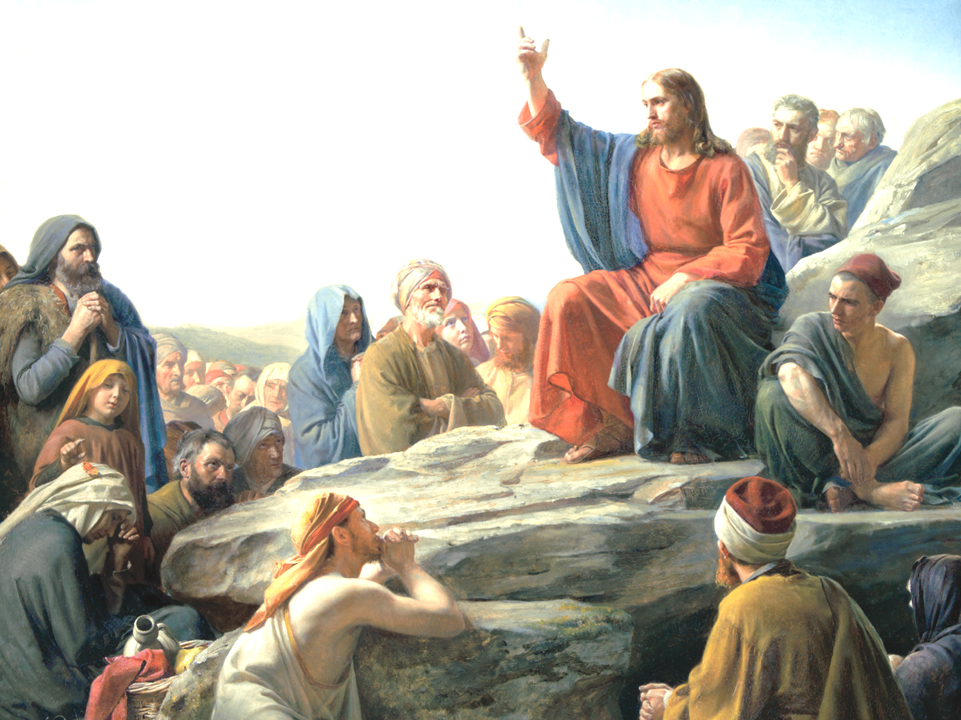
Seeing all these crowds following him, Jesus went up on a mountain, and he began to speak.
The Sermon on the Mount is long. The teachings contained in it are numerous.
It begins with the beatitudes. It includes phrases like “you are the salt of the earth and the light of the world.” It includes teachings like the ones we heard last week, about murder and adultery and divorce, and how the desires and intentions of the heart are just as important as the actions one performs. It includes instructions to turn the other cheek, walk the extra mile, and love your enemy.
And all that’s just in chapter five. There’s still chapter six and chapter seven.
Scholars believe that the Sermon on the Mount actually contains teachings that Jesus gave on numerous occasions. This would all be too much for one sitting, don’t you think? But Matthew took all these things that Jesus taught and preached on various occasions, and - for the sake of simplicity - combined them all into one dramatic scene.
A little later in the Sermon on the Mount, Jesus says: “No one can serve two masters; for a slave will either hate the one and love the other, or be devoted to the one and despise the other. You cannot serve God and wealth.”
Then Jesus describes many things that people in his day were worried about: buying clothes to wear, figuring out what they were going to eat, wondering how they were going to pay for such things. Apparently there was a lot of stress about how to afford things such as food, clothing, and shelter. People were always asking, “What will we eat?” “What will we wear?”
These are things worth worrying about, are they not? Food and clothing are important. I sometimes worry myself how I can continue to afford the food and the clothing that my family needs.
On the other hand, I know most of us have closets full of clothes, and we still worry about what we will wear. Does this shirt match my shoes? Did I wear this same outfit last time? Do these pants make my butt look good?
And most of us have food at home. But we look at the pictures our friends post on instagram, of the marvelous meals they eat at some amazing restaurants, and we worry that the food we’re eating is, well, boring.
Jesus says: “Don’t worry about it. Gentiles worry about such things, but you - people of faith - should not. The only thing you should be concerned about is God’s kingdom. Worry about that - make that your priority - and everything else will fall into place.”
I don’t know how literally to take this. It does sound as if Jesus means it, that he really means what he says.
But, stop worrying? As if I could!
Although Jesus doesn’t exactly say “stop worrying.” He says, “stop worrying about the wrong things. Stop focusing your attention on things that are less important, and start focusing your attention on things that are more important.”
In other words: “get your priorities straight.”
What do we, as a church, worry about? What are the conversations in board meetings and in the parking lot that make us anxious? Are our priorities straight? How much of our focus is on the kingdom of God?
To focus more of our attention on the kingdom of God - to truly make the kingdom of God our first priority - we need to understand what the kingdom of God IS. And one of the best ways to understand what the kingdom of God is, is to read… the Sermon on the Mount.
The footnotes in my annotated Bible refer to the Sermon on the Mount as the keynote of the new age that Jesus came to introduce. And that new age IS the kingdom of God. If you want to know what the kingdom of God is… read the Sermon on the Mount.
And if you are particularly knowledgeable about the Bible, you will realize - when you read the Sermon on the Mount - that the ideas Jesus presents parallel the ideas, the visions & dreams, of the prophets.
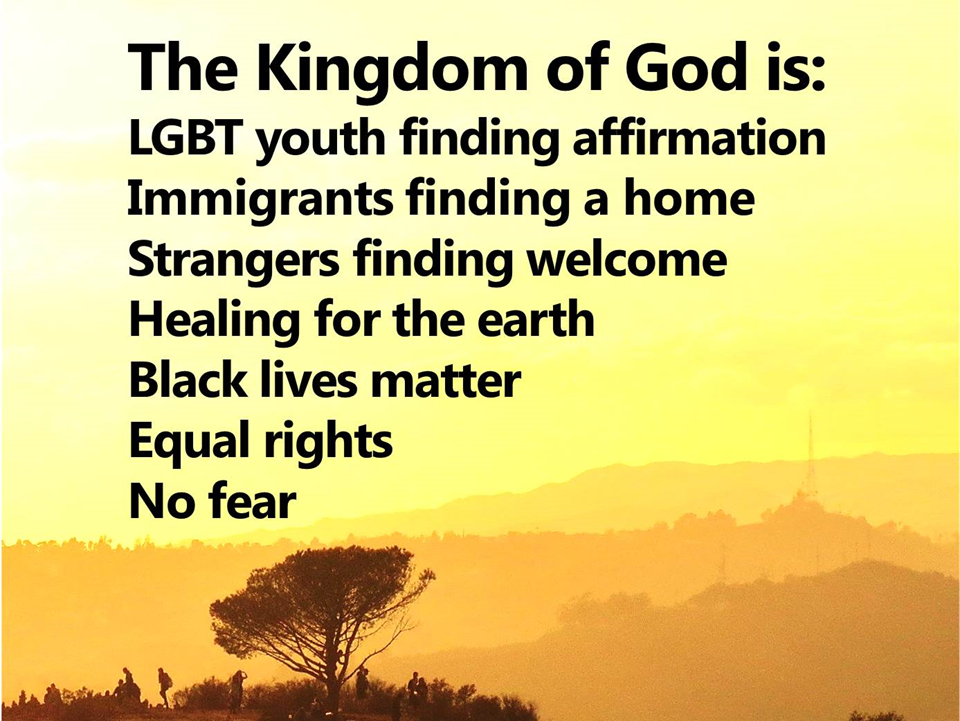
The kingdom of God is the vision of the prophets. It is a world where all live in wholeness and harmony. It is the beloved community. It is no obstacles and no fear. It is peace, justice and equality.
Read the prophets. Read Jesus’s Sermon on the Mount. And you will see:
The kingdom is every valley being exalted and every hill being made low, the rough places made plain and the crooked places made straight.
The kingdom is a world in which all people are recognized as being created equal.
The kingdom is people of all colors and races respecting each other’s dignity and worth.
The kingdom is people of all sexual orientations and gender identities finding affirmation and pride in who they are, who they were created to be.
The kingdom is Christians and Jews and Muslims and Buddhists and B’hai and all religions of peace living in community, in solidarity, without fear, working together to create a better world.
The kingdom is all people finding a home where they can be safe, where they can raise families, without fear of raids or deportations that tear families apart.
The kingdom is every person who experiences sadness and sorrow, finding comfort and support. The kingdom is every person facing struggle, every person dealing with addiction or mental illness, finding understanding and encouragement.
The kingdom is health care for all people. Jesus was a healer. He cured people, healed people. There is healing for all in God’s kingdom.
The kingdom is reverence toward the earth, understanding that everything is sacred and that nature is worth protecting and defending.
The kingdom is a fair distribution of wealth and resources among people.
The kingdom is holding businesses and elected officials to high ethical standards, demanding that they listen to the people and that they use their power and wealth to protect the poor instead of focusing on how to create more wealth for the one percent.
The kingdom is where the poor are blessed; where those who mourn are blessed; where those who hunger and thirst for what is right are blessed; where those who are persecuted for doing what is right are blessed.
From the Sermon on the Mount, from the other teachings of Jesus, from the writings of the apostle Paul as well as the ancient prophets, we see that this is the kingdom of God.
And every time we read in the Bible about salvation, it is talking about these things. In the Bible, the word translated as “salvation” comes from the Greek word “sozo,” which literally means to be made whole, to be made well, to be healed. Salvation means wholeness. Being saved means being made whole. Those who live in the kingdom of God live in wholeness.
So the question is: is this what we are seeking after? Is this where our attention is focused? Is this what we seek first before all other things?
If there is one thing that Black History teaches me, it’s that too many churches - and too many church leaders - are not focused on these things. They’re not focused on the kingdom of God.
Too often, the church is complacent when it comes to the kingdom of God.
Sometimes, church leaders pretend that the kingdom of God has nothing to do with this present world. Prominent church leaders in this country have recently said, for example, that issues like immigration are not issues of faith.
It makes me wonder if they have even read the Bible they constantly wave about. The Bible talks repeatedly about welcoming strangers, about showing hospitality to others… it’s a major theme that appears over and over.
Martin Luther King, Jr. got so frustrated with the church. He was a minister, and he loved the church, but he got frustrated. More often than not, church leaders - white church leaders - said they were sympathetic to his cause, but they told him to slow down, to step back, to not be so extreme. They told him to not march in the streets, to not break laws by organizing unlawful protests, even if the protests were nonviolent.
Their focus wasn’t on the kingdom of God. Their focus was on keeping their congregations happy, keeping their reputations in the community, trying to keep everyone happy.
Martin Luther King Jr. said that this made him realize that “few members of a race that has oppressed another race can understand or appreciate the deep groans and passionate yearnings of those who have been oppressed, and still fewer have the vision to see that injustice must be rooted out by strong, persistent and determined action.” [Letter From a Birmingham Jail]
King also noted that many ministers would say to him that the issues he fought for were “social issues with which the gospel has no real concern.” That’s an easy lie to tell when you want to focus on other things than the gospel. But the gospel, the kingdom, is precisely about freedom and equality and hope. It’s the liberation of the Jews who were slaves in Egypt. It’s the persistent vision of the prophets. It’s the new age described by Jesus. It is exactly what the gospel is all about.
Is this what we are focused on? Is this what you are focused on as a Christian, as a follower of Christ? Can you truly say that you seek first the kingdom of God?
If you’re not sure, spend some time this week reading the Sermon on the Mount. Gandhi read from it every day, and he wasn’t even a Christian,... yet he recognized its value.
It is the keynote of the new age, the new kingdom, the kingdom of God.
It’s Matthew, chapters 5, 6, & 7.