
Showing posts with label Isaiah 2. Show all posts

Sunday, July 9, 2017

Sermon: "Onward Christ's Disciples" (Isaiah 2:1-5)

My earliest memories of church involve sitting in little wooden chairs for Sunday School. You young people may not know, but back in my day, Sunday School was just that: a whole school of classes for various age levels that met one hour before the main worship service on Sunday mornings. Here at Bixby Knolls Christian Church, we have a remnant of the old Sunday Schools, our adult Bible study class that meets before worship.
At my childhood church, Sunday School often began with all the grade levels in one room. There was an old upright piano in there, and we would sing a few songs before going off to our separate classes. Usually the children got to pick out the songs, and we picked out the same two songs every single week. It probably drove our teachers crazy.
One song that we picked was,“He Lives” (“I serve a risen Savior, he’s in the world today…”); and the other was, “Onward Christian Soldiers” (“Onward Christian soldiers, marching as to war…”).
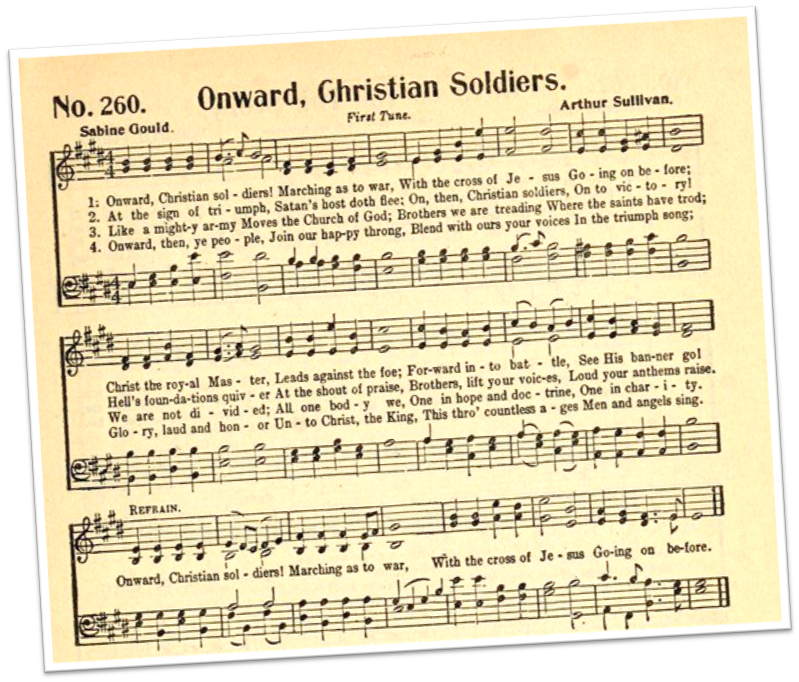
It just wasn’t Sunday morning at church if we didn’t sing those two songs.
I guess we liked the way those songs sounded. They both move at a good pace, a good marching pace; “Onward Christian Soldiers” especially. They certainly didn’t drag along slowly and lethargically like some of the other hymns we were used to hearing. They had energy and passion and excitement.
When I was in high school, I started to hear people talk about how one of those two songs - “Onward Christian Soldiers” - wasn’t really appropriate, because it is full of war imagery, and Christians are supposed to be people of peace. And yes, it’s about spiritual warfare, but even so, it was deemed theologically inappropriate.
I was disappointed, because of my happy memories of singing that song; but when I looked at the lyrics, I had to admit that they were right. “Onward Christian Soldiers marching as to war… like a mighty army moves the church of God...” It’s about armies and crusades and going forward into battle.
“Onward Christian Soldiers” was written in 1865, right at the end of the civil war, and draws its inspiration from 2 Timothy 2:3. The Salvation Army even adopted it as their official hymn.
Of course they did.
However, Jesus never used imagery like this. Jesus said that the way of the sword was not his way. Jesus built upon the teachings of the prophets - prophets like Isaiah, who said that, in God’s ideal world, there would be no war, and that swords would be made into iron plows, and spears would be made into tools for pruning. Jesus never called people to take up arms against enemies or oppressors, but he did weep openly for the people who did not know how to make peace in their communities.
Given all this, lyrics about warfare and battles and marching into war really aren’t appropriate to Christian worship.
So we stopped singing “Onward Christian Soldiers.” And by “we,” I don’t mean just the church I grew up in. I mean many, many churches stopped singing it. And hymnals stopped including it. It’s not in the Chalice Hymnal. And that is as it should be.
All that being said, there was one good thing about Onward Christian Soldiers and its battle imagery: it motivated us. It energized us. It got us excited. It told us that we were going into battle because we had a cause that was worth fighting for!
I think that’s why American Christianity held on to battle imagery and metaphors for as long as it did.

As I got a little older, my musical tastes changed. I got excited by some Christian rock bands: Stryper. Petra. They weren’t just rock; they were hard rock. Talk about music that excited a person! The first big concert I ever went to - out at Irvine Meadows - was Petra.
Like many Christians before them, these bands liked the war imagery, and though I liked the excitement and passion in their music, the war imagery made me uncomfortable. Petra even had a song titled, “This Means War.” It was loud. I won’t ask Barb to play it on the piano.
I cringe when I hear those songs now. And I think Jesus does, too. They don’t reflect the kind of savior Jesus is. Jesus refused to take up arms, even to defend his own life. Instead, he chose to bring life to others through sacrificial love and compassion.
Which makes the use of battle and war imagery inappropriate to the way of Jesus.
So we’ve gotten rid of it. Mostly. To follow more closely the way of Jesus, we avoid using violent imagery and metaphors.
Unfortunately, without all that, it’s been difficult to maintain the same level of passion, excitement, and motivation. You know what I’m talking about, right? “We’re waging a battle! Join the fight!” It all has such a good, powerful ring to it. But where is that excitement and passion today?
With such language and imagery no longer available to us, I feel as if we’ve become somewhat lethargic in our faith. Apathetic, even. Or maybe just plain lazy. We’ve lost some of the fire, the spirit, the passion that we once had back in the day - back in the day when we used images of wars and battles. We haven’t figured out a way to motivate, inspire, and energize since we gave all that up.
I’ve been thinking about all this...pondering these things... searching for an appropriate language that can replace language that is violent; I’ve been searching for language that can still motivate and inspire and energize without speaking of battles and warfare.
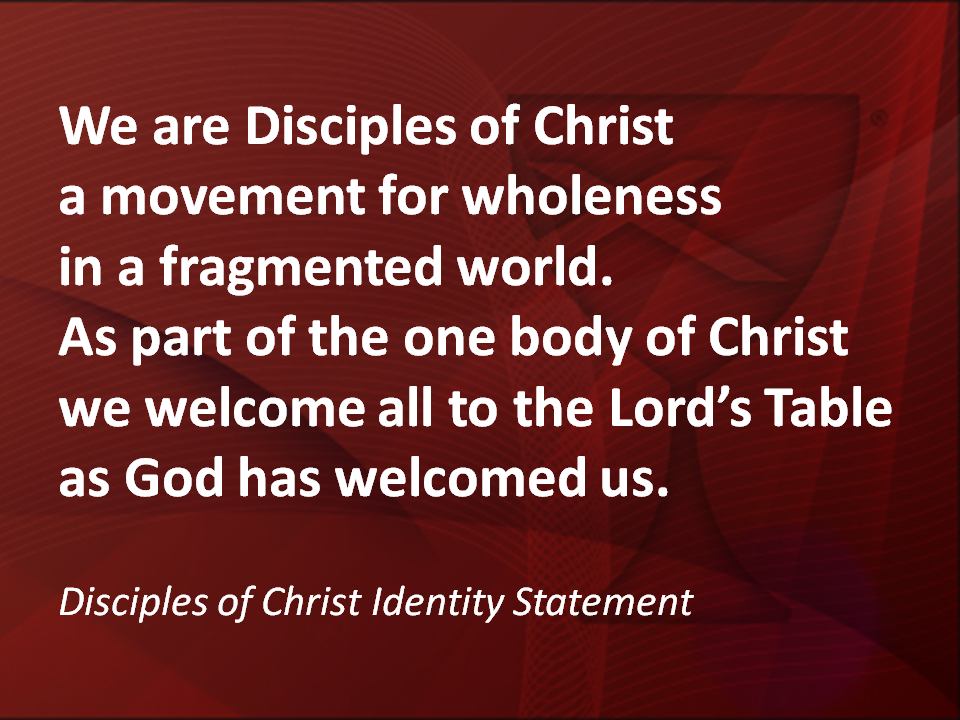
And I think I found it. Actually, it has been staring me in the face for quite some time. It’s our identity statement - the identity statement of the Christian Church (Disciples of Christ).
You’ve heard me recite this statement before. Right now, I want you to recite it with me…
We are Disciples of Christ, a movement for wholeness in a fragmented world. As part of the one body of Christ, we welcome all to the Lord’s Table, as God has welcomed us.
If you were at the General Assembly that is taking place right now in Indianapolis, you’d be hearing this language a lot.
We are a movement for wholeness! Not an army or a crusade, but most definitely a movement. A movement for wholeness…
And wholeness, we know, means healing, salvation, peace, shalom, aloha, having things put back together so all is right again, so all is restored to as it should be.
And, we are Disciples! Not soldiers, not warriors, but Disciples! We are disciples in the movement.

And we have a cause that is worth devoting our lives to. It’s the cause of justice, the cause of peace, the cause of love and equality.
This is something worth getting excited about! This is something worth being passionate about! It is our calling. It is our mission.
And when we are moving toward wholeness in our lives and in our world, I feel that passion and excitement.

It’s what made the mission trip to Hawaii that I led so meaningful. Let me tell you what I mean.
In Hawaii, our group of 16 divided up into smaller groups, and each smaller group was created to be as diverse as possible.
In my group of five, we had hispanic, African-American, Korean-American… and me. One day we went to a farm that practiced traditional Hawaiian farming, preserving and teaching Hawaiian culture while growing food. We worked in the kalo lo’i, in watery mud up to our chests, side-by-side with interns who were descended from the first Hawaiians.
And as we worked, we talked. And we listened. And we learned about each other’s lives and built lasting friendships.
These were amazing conversations! Conversations that many in the world say we shouldn’t be having.
The world instills in us a prejudice that too easily takes the form of racism. The world tells us that we shouldn’t be having conversations like the ones we had in Hawaii, that we shouldn’t be having conversations like the ones we have here in our own congregation, conversations that transcend barriers of race and culture and age.
But we did.
And we do.
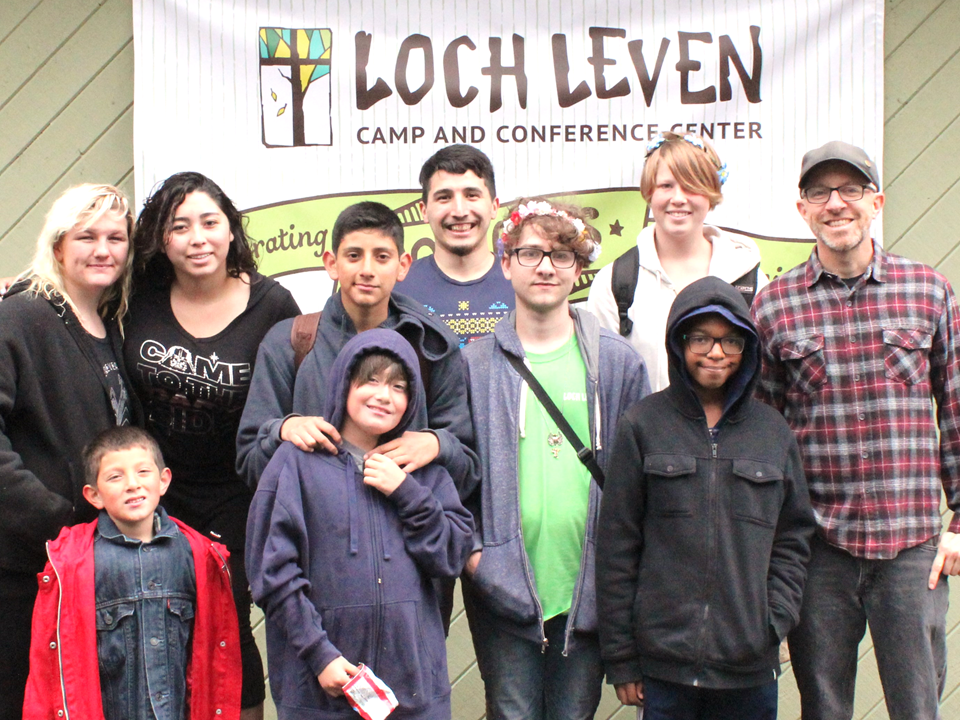
So many in the world are trying to divide us, trying to shape our world into a world of hostility, a world of fear, a world of separation, but we are doing just the opposite. We are shaping the world into a world of friendship, a world of peace, a world of unity.
That’s what it means to be a movement for wholeness in a fragmented world.
I am super excited about this! This is what fuels the passion within me….
Something amazing was happening in that Hawaiian mud, and something amazing happens every time we gather together here at Bixby Knolls Christian Church for worship.
We take it all for granted, but it truly is amazing. There are so few places in this world where this is happening! There are so few places where people who are of various races and cultures and generations and orientations and identities gather together, around a table, in love and friendship and unity.
Yet this is who God has called us to be. This is who we are. We are Disciples of Christ, a movement for wholeness in a fragmented world. And, as part of the one body of Christ, we welcome all to the Lord’s Table, just as God has welcomed us.


Sunday, November 27, 2016

Sermon: "Peace. Justice. Righteousness." (Isaiah 2:1-5)

Isaiah was a prophet. A prophet is a person who looks at the world as it is, and compares it to the world as it could be. Prophets call upon the people of the world to get rid of the things that are preventing the realization of an ideal world. Prophets describe what a new, alternative world would look like, and call the people to make that alternative world a reality.
In Isaiah’s vision, this better world becomes a reality when all people seek the Lord’s ways. Instead of insisting on their own way, they empty themselves of every selfish thought. They open themselves up completely to receiving instruction from God. And this instruction from God, this teaching, will be in the way of peace and justice and righteousness. Shalom and mishpat and tsedeq.
Having been instructed in the way of peace and justice and righteousness, all people will show love for their neighbor. There will be no animosity among people.
Peace will be so complete that even the animals will get along, even predators and prey! We’ll hear more about this next week, about the wolf living with the lamb, the leopard lying down with the kid, the calf and the lion and the fatling together… Babies and children will play alongside venomous snakes, and no harm will come to them. They will not hurt or destroy. Why? Because the earth will be full of the knowledge of the Lord.
Isaiah’s vision involves people “from all the nations.” No matter what your views on immigration are, it’s important to realize that Isaiah’s vision involves everyone. We don’t enter into that vision on our own. There isn’t even a separate gate.
When I came home to the United States from Brazil, at the airport, going through customs, there were two lines: one line for US citizens, and a second line for non-citizens.
Isaiah’s vision involves only one entrance, only one gateway, and it is wide enough to receive everyone. All people, from all nations. Foreigners and eunuchs and anyone else who has been denied entry elsewhere, denied equal rights, denied freedom – they will all be welcome.
“All peoples and all nations” includes people of different races. “All peoples and all nations includes people of different religions. “All peoples and all nations” includes the LGBT community.
All peoples, all nations.
And they shall all be instructed in the way of the Lord.
Now, what does that mean: “They shall be instructed in the way of the Lord”?
For much of church history, many thought that “instructing people in the way of the Lord” was something that was forced upon people. It meant using the sword to instruct people in the way of the Lord. Convert or die.
When the Americas were conquered by Europeans, the Europeans tried to beat indigenous people into becoming followers of Christ.
But look again at Isaiah’s vision: no weapons. No swords. No spears. Nothing that causes harm. Such things are not a part of the vision. The way of the Lord does not come to people by force. It comes by way of love.

Let me say it again: Isaiah’s vision is a vision of peace, justice and righteousness. Shalom, mishpat, tsedeq.
These three words are practically synonyms. They describe a state of things in which all is as it should be. Everything is put right. The vision Isaiah has for the world is a vision of shalom, mishpat, and tsedeq.
Shalom: we translate it as peace, but it’s more than just the absence of war or conflict. It’s complete harmony between all living things.
Mishpat – that’s the word for justice: it doesn’t mean giving bad people the punishment they deserve. Some people think of the word “justice” that way, but the biblical idea of justice is restorative justice. In other words, when things go wrong, justice searches for a way to mend what is broken and put things back together again. It means those who have been broken and hurt find healing and wholeness.
And Tsedeq. Righteousness. We think of righteousness as a word to describe someone who is holier-than-thou. Self-righteous. But righteousness in the Bible simply means what is right. What is good.
Justice and righteousness do not imply “an eye for an eye.” That phrase comes from the Old Testament, and it was an instruction given as a limit. In other words, people were often exacting terrible revenge when they had been wronged, so the instruction came to them: “no more than an eye for an eye.” Control your anger, your rage, your desire for retribution.
And anyway, retribution is never as satisfying as one might expect. A long time ago I was reading to my boys Artemis Fowl – The Eternity Code, and one line from those books I still remember. Juliet had just taken out the bad guy, which, you might expect, would be a cause for celebration – both for Juliet, and the reader. After all, the bad guy was no more. He had been eliminated. And yet, the next line in the book reads:
“Juliet had expected to feel some satisfaction, but all she felt was sadness. There was no joy in violence.”
There’s a powerful truth there.
A few weeks ago, California had the opportunity to abolish the death penalty. We didn’t, which is unfortunate. Common, simple logic should tell us that killing people in order to demonstrate that killing people is wrong makes no sense.
And families of victims often expect to find satisfaction when the person who killed their loved one is executed, but they usually are surprised to find that there is no satisfaction to be found there. The murderer who killed their loved one is executed, and they expect that to bring them some satisfaction, but it never does.
Isaiah knows this to be true. So that is part of Isaiah’s vision. No violence, for any reason.
This was also a part of Jesus’s vision; when the guards came and his disciples drew their swords to fight, Jesus said “Stop! That is not my way.”
It makes sense that Jesus’s vision and Isaiah’s vision would be the same, because really, they are both God’s vision.
I recently read a book by Shane Claiborne titled, Executing Grace. One chapter talks about the genocide in Rwanda. It’s probably safe to say that a country in which genocide is taking place is as far from the vision of God as it is possible to be.
But in the years that followed, the people of Rwanda asked: “What does justice look like?”
They decided that justice did not involve more killing. They were tired of killing. They were tired of blood. No more, they said. That is not the world we want to live in.
So in the years that followed, those responsible for the genocide were not executed. In fact, Rwanda abolished the death penalty. And those who were responsible for the genocide were put to work, literally. “Their punishment was to help rebuild the nation they had helped destroy.”
This is restorative justice. This is justice that searches for a way to mend what is broken and put things back together again.
You see the difference between restorative justice, and criminal justice? Criminal justice asks what laws were broken, and how can we punish the one who broke them. But restorative justice asks ‘Who has been hurt by this, how can the hurt be healed, and who is obligated to work on behalf of that healing?’
Shane Claiborne also writes about a kid who was caught dealing drugs at a Quaker school. “The entire community came together, because the offense had affected the entire community. The conversation that ensued reflected a deep, genuine concern for this young man and a deep, genuine concern for the community. The questions that were being asked were not just ‘Should he go to jail?’ Students were asking things like, ‘Are you in need of money? Are you, or any of us, struggling with addiction?’ (because obviously, this student had buyers – others were involved). And: ‘What harm has been done?’” And with those questions, these 15 year-olds began to figure out how to restore wholeness to their fragmented community.
This kind of work is how we make Isaiah’s vision a reality. And that is our calling. Isaiah’s vision is a vision for the future; but it is also a vision for the present. There’s a lot of future tense here. “They will come, they will learn, there will be peace…”
But then Isaiah says, “Come, let’s walk in the light of the Lord.” That is an invitation to enter the vision now.
And right now, right here, it’s happening.
CCEJ – the California Conference on Equality and Justice – works with the Long Beach Unified School District to bring restorative justice into our schools. When a student misbehaves, restorative justice asks the person who caused harm to take responsibility for their actions. Restorative justice helps the person who was harmed to find healing. And Restorative justice involves the community as a whole to offer support and encouragement.
Restorative justice is an alternative to more traditional methods such as suspension. Suspension does little to bring healing or wholeness. Students who are suspended are three times more likely to drop out of school, and more likely to be incarcerated.
CCEJ works with the school district to train teachers and administrators in Restorative Justice. CCEJ is also working with the Long Beach Police Department to find ways that Restorative Justice can work in our community.
So even though Isaiah’s vision is a dream of the future, and sounds rather utopian, it can be – and in fact is – a reality in our present world.

And as I said, this vision that Isaiah had became Jesus’s vision too. Throughout the hymns we sing in Advent and Christmas, the vision of a better world is presented. As you sing the songs and carols this Christmas season, let the vision they present sink into you. Let the vision fill you. Let the hope of a new world live in you. Know that it is possible to live in that better world today, tomorrow, and forever. 

Sunday, November 28, 2010

"There Will Be Hope" Isaiah 2:1-5

I went and saw the latest Harry Potter movie this week. Fortunately I was away last weekend; otherwise my kids may have forced me to endure waiting in a much too long line to get in to a much too crowded theater to see it. Instead, we went to a midweek matinee; more affordable, less crowded, more relaxed.


We have all seven Harry Potter books at home. They are in various stages of falling apart. Paper dust sleeves are torn or missing; bindings are breaking; pages are coming loose. These books, I regret to say, show the evidence of having been handled and read even more than our family’s Bibles.

In what is probably a poor attempt to justify this imbalance in our reading habits, let me just say that there are many who see in Harry Potter themes that are distinctly Christian. Being a story about wizards and witches, there are of course many powers on display, powers that “muggles” like you and I can only dream about: powers to do spells, leave enchantments, and create magical potions. But guess what the greatest power of all is?

I’ll give you a hint. The greatest power of all is a power Harry Potter has, but the evil Lord Voldemort does not. Remarkably, it is a power that even non-wizards are capable of possessing. It is the power that Harry received when his own mother died in order to protect him, a power that Harry himself exercises in the final, climactic scenes of the entire series.

It is the power of love. And isn’t the power of love what we see at the very heart of the gospel? Isn’t that what we see in both the birth and the death of Jesus?

The whole plot of the Harry Potter series begins when a prophecy is given. The shortened version of the prophecy, the one that appears in the movies, goes like this: The one with the power to vanquish the Dark Lord approaches...and the Dark Lord shall mark him as his equal but he shall have power the Dark Lord knows not...For neither can live while the other survives.

In an article I read online, scholars Karl and Rolf Jacobson write that this Harry Potter prophecy is the type of prophecy we usually think of when we read biblical prophets like Isaiah. We usually read them as predictions of future events that will one day come to pass. Most often, Christians read biblical prophecies as predictions that are fulfilled in Jesus.

In seminary, I learned that this is not really the way biblical prophecy was meant to be understood. Prophets like Isaiah, despite sometimes speaking in future tense, spoke of current events, not future ones. Prophecies that we apply to Jesus, I learned, were actually written in reference to contemporary figures; people like Cyrus, a ruler who liberated the Israelites from Babylonian captivity. He was, at the time, their liberator, their redeemer, their savior. He was the one they believed to be anointed by God.

Well, you can imagine what sometimes happened when seminaries like me, armed with this new knowledge, graduated and began preaching it in unsuspecting congregations. At best, the message was confusing. At worst, it was damaging.

Because even though we were right, we weren’t completely right.

Readers of the Harry Potter series know that there is some ambiguity in that story’s prophecy. It never actually mentions Harry Potter by name. It could, in fact, have applied to another wizard, born about the same time as Harry Potter; Harry Potter doesn’t become the one to fulfill the prophecy until someone – Voldemort, in fact – chooses to apply the prophecy to him.

The prophecies of Isaiah and other biblical prophets were written in regards to contemporary events and people. That is important to know. But it is also important to know that early Christians chose to apply them to Jesus; and it is important to know that they did not do so ignorantly. They likely knew about the prophecies’ original, historical contexts. But in the first century, they saw a new context. In Jesus, they saw a new fulfillment.

It doesn’t end there. As we begin our journey through Advent, we begin, once again, reacquainting ourselves with the vision God has for our time. We begin asking ourselves, once again: How will God use us to bring about the fulfillment of the kingdom of peace and shalom described by the prophets, described by Jesus? How will we use the power of love to transform our world, to restore hope to the nations, in 2010, 2011, and beyond?

The vision of the prophet Isaiah that we have before us today is a vision, a prophecy, of a world of peace; a world where all people will look to God for instruction and all nations will look to God to arbitrate and mediate for them; a world in which weapons of warfare will be beaten into tools of cultivation; a world in which war will be no more.

Clearly, for such a world to happen, we must make use of the power of love, the greatest power, the more excellent way; and who showed us how to do this better than Jesus? This scripture is fulfilled in him.

But what was this prophecy’s original context? That’s an interesting question, and one that would probably take too long to answer; because this particular prophecy appears almost word-for-word in the book of Micah. It also appears, in somewhat altered form, in the book of Joel.

Joel actually injects a bit of sarcasm by flipping the prophecy on its head. “Prepare for war,” Joel says. “Call up the soldiers. Beat your plowshares into swords, and your pruning hooks into spears. Go ahead and honor your war heroes; God will shatter them. Go ahead and judge the nations around you, because God is the judge of all nations; God will judge them and you alike.”

The reference to honoring warriors and war heroes is interesting, because, in fact, the people of Israel rarely did that. They lived in a very tumultuous time and place. War was almost a daily part of ancient Israelite life. The Old Testament is filled with accounts of war and invading armies. And yet Israel did not glorify warfare.

The surrounding nations did. They built monuments and decorated their palaces with scenes depicting the slaughter of their enemies, often in gruesome detail.

Israel seemed to live by a different vision.

That doesn’t mean Israel didn’t have armies; it did.

That doesn’t mean Israel didn’t defend itself; it did.

But as I read in another online article – this one by Baylor University religion professor John Wood – Israel’s militarism was a constant source of debate: “How can Israel be a ‘light to the nations’ while taking up arms against them? How can God be both a God of peace and a God of war?”

This debate plays out through much of the Old Testament, and no final answer is ever reached. More than once, a particular battle that is described in two or more different biblical books is described very differently, depending on the viewpoint of the one doing the describing.

And, of course, it is a debate that continues today. How can one country be a light to the nations while stockpiling weapons of mass destruction? What is the proper justification for people of faith, people of peace, to go to war? Is there ever such a justification?

It may be that we will never reach consensus on these questions, but as long as we keep asking them, there will be hope.

As long as we keep the prophetic vision of a peaceful world, there will be hope.

As long as we recognize the potential for that prophecy to be fulfilled in our time, through us, through Christ working in us, there will be hope.

As long as we remember that the greatest power of all, the power of love, lies within us, there will be hope.